![Crystal Dew World [en]](http://crystalmark.info/en/wp-content/uploads/sites/3/digipress/magjam/title/TitleLogo20250202-Cinzel.png)
1. Introduction
CrystalDiskInfo, first released in 2008, has finally surpassed 100 million cumulative downloads!
A lot can happen over 18 years of software development.
When I first started working on CrystalDiskInfo, I never imagined I would still be developing it 18 years later. And I certainly never dreamed that it would one day reach 100 million downloads.
To everyone who has used CrystalDiskInfo over the years, thank you so much!
CrystalDiskInfo did not grow into what it is today through my efforts alone. I have received countless suggestions and requests from users, invaluable technical assistance from fellow programmers, and tremendous support from people who have helped with translations, testing, and so much more.
To celebrate this milestone, I would like to look back on what inspired me to create CrystalDiskInfo and some of the most memorable events along the way.
Most of these stories are from quite a few years ago, but I hope you will enjoy this little trip down memory lane.
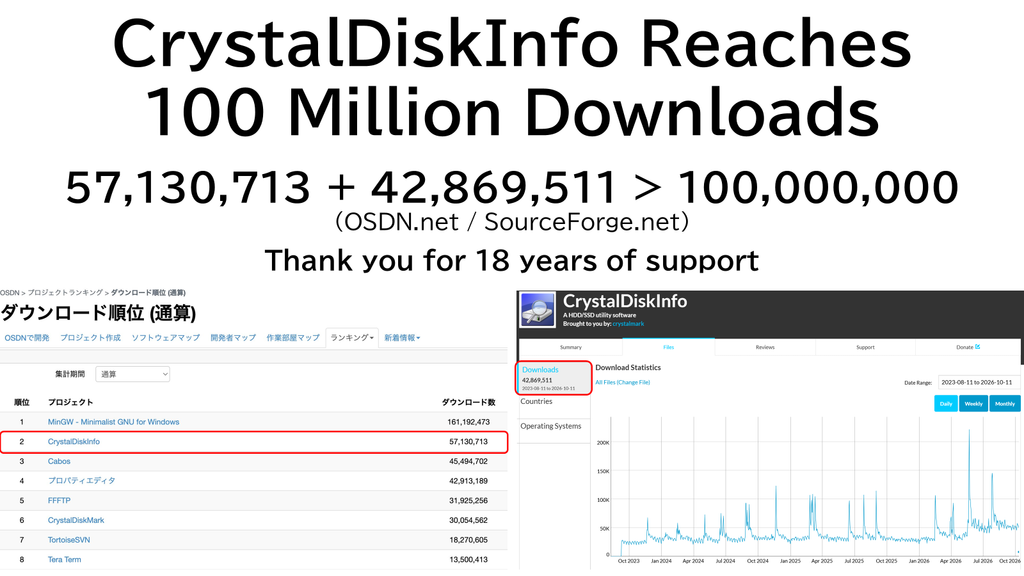
About the 100 million download milestone:
The total is based on download statistics from OSDN.net (now defunct) and SourceForge.net combined.
- Downloads from numerous third-party mirror sites around the world are not included.
- The statistics also include a small number of source code and related data downloads. As these account for only a tiny fraction of the total, no adjustment has been made.
2. How CrystalDiskInfo Began
One of the inspirations behind CrystalDiskInfo was a research paper published by Google in 2007, titled Failure Trends in a Large Disk Drive Population.
The paper analyzed failure trends across a large number of hard disk drives and demonstrated certain relationships between S.M.A.R.T. data and HDD failures.
Of course, S.M.A.R.T. data alone cannot predict every drive failure. Nevertheless, detecting early warning signs might give users a chance to back up their important data or replace a failing drive before it is too late.
There were already plenty of storage health monitoring tools available at the time, but I couldn’t find one that felt like the definitive solution.
So I thought, why not make one myself?
…Well, that is the serious explanation.
There was actually another inspiration behind CrystalDiskInfo, although it is a little harder to explain. (LOL)
Toward the end of 2007, I had reached something of a dead end with CrystalCPUID, a CPU information utility I was developing at the time, and was wondering what to work on next.
One day, while casually browsing a video-sharing website, I came across a gameplay video featuring a rather dreamy premise: a princess from the Moon comes to stay at someone’s home.
It was August’s Yoake Mae yori Ruriiro na.
I became completely absorbed in watching it, but the video ended right at the most interesting part!
I was so curious about what happened next that I immediately bought the PlayStation 2 version. Needless to say, I spent much of the New Year holidays playing the game.
Then, shortly after the new year began, I somehow received a divine revelation from the princess of the Moon, telling me to create a storage information utility. (LOL)
I was already developing CrystalDiskMark, so a storage information utility seemed like a good opportunity for synergy. I had also gained some experience retrieving storage information while developing CrystalMark 2004.
Most importantly, storage technology seemed to be fairly well standardized. I assumed that once I had implemented the necessary functionality, I wouldn’t have to make major changes every time a new product appeared.
Looking back, I have absolutely no idea what made me think that.
Ignorance is bliss… or perhaps a little terrifying. (LOL)
As it turned out, I would spend the next 18 years struggling to support new standards and vendor-specific implementations.
In any case, the inspiration I received from Google’s research paper, combined with my encounter with an August game, led to the birth of CrystalDiskInfo.
I remain deeply grateful to August, whose wonderful work had such a profound influence on my life as a software developer.
3. A Comment on a Major Japanese Internet Forum
In March 2008, I released a beta version of CrystalDiskInfo 1.0 and was preparing for its official release on March 31.
Initially, I thought that retrieving and displaying a list of S.M.A.R.T. attributes would be sufficient for the first release.
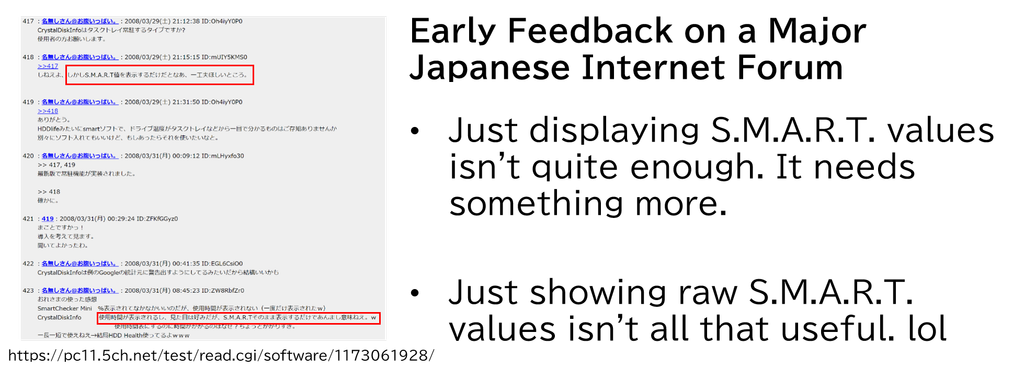
Then I received some rather blunt feedback on a major Japanese Internet forum.
“Just displaying S.M.A.R.T. values isn’t quite enough. It needs something more.”
And another comment:
“Just showing raw S.M.A.R.T. values isn’t all that useful. lol”
Hmm… they had a point.
I had already received various feature requests from users in Japan and around the world. My original plan was to release the first version and gradually implement those features in subsequent updates.
But the more I thought about it, the more I realized something important.
If the initial release of a new application isn’t particularly useful or impressive, users might never give it a second chance, no matter how much it improves later.
That would be such a waste after putting so much effort into creating something new.
So I decided to postpone the official release and put in one more big push.
Features that I had originally planned for future versions—including background monitoring, notifications, and graphing—were implemented all at once.
Looking back at my development records from that period, I was working at an astonishing pace.
I’m fairly sure I was also quite busy with my day job at the time…
When on earth did I find the time to do all that coding? (LOL)
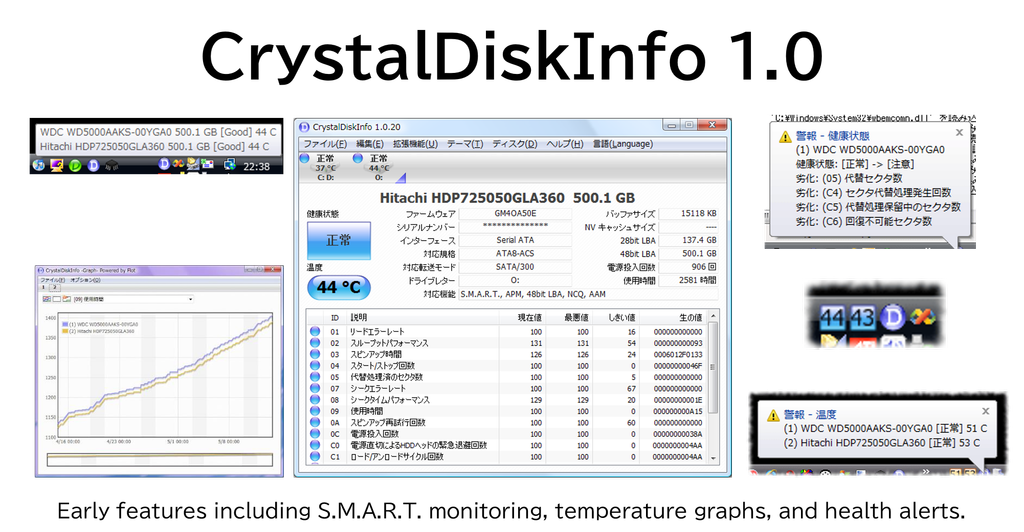
And so, on May 22, 2008, CrystalDiskInfo 1.0 was officially released.
If I had released it on March 31 as originally planned, it might have disappeared into obscurity as just another ordinary storage information utility.
Of course, there is no way to know what would actually have happened.
But I believe that taking the time to include a solid set of features and make the first release genuinely useful played an important role in its eventual popularity.
Even now, 18 years later, I am grateful to those anonymous forum users who gave me such honest feedback.
4. A Hero Appears! The Road to USB-HDD Support
After CrystalDiskInfo was released, I began receiving all kinds of requests from users around the world.
One of the most common requests was support for USB-connected hard drives.
Today, retrieving S.M.A.R.T. information from USB-HDDs may seem perfectly normal, but things were very different back then.
The fundamental problem was that I simply didn’t know how to send ATA commands to hard drives connected through USB.
I searched the Internet, read technical documentation, and experimented with various approaches, but I couldn’t even find a promising starting point.
Just when I was wondering what to do, something remarkable happened on August 15, 2008.
A hero appeared on the Crystal Dew World discussion board!
A contributor using the name “HGST user?” provided a patch implementing SCSI/ATA Translation support.
A legendary patch had arrived! !!━━━━(゚∀゚)━━━━!!
I immediately integrated the patch, and suddenly the path toward USB-HDD support was wide open.
Unfortunately, that didn’t mean all the problems were solved.
At the time, many USB-to-ATA bridge chips used vendor-specific commands, requiring separate support for individual chipsets.
And, of course, documentation for those proprietary commands was generally unavailable.
So I had little choice but to buy USB-HDD enclosures and conversion adapters, then use a USB protocol analyzer to investigate the commands sent by the vendors’ own utilities.
I would analyze the commands, implement support, and test everything on actual hardware.
Then repeat.
Over and over again.
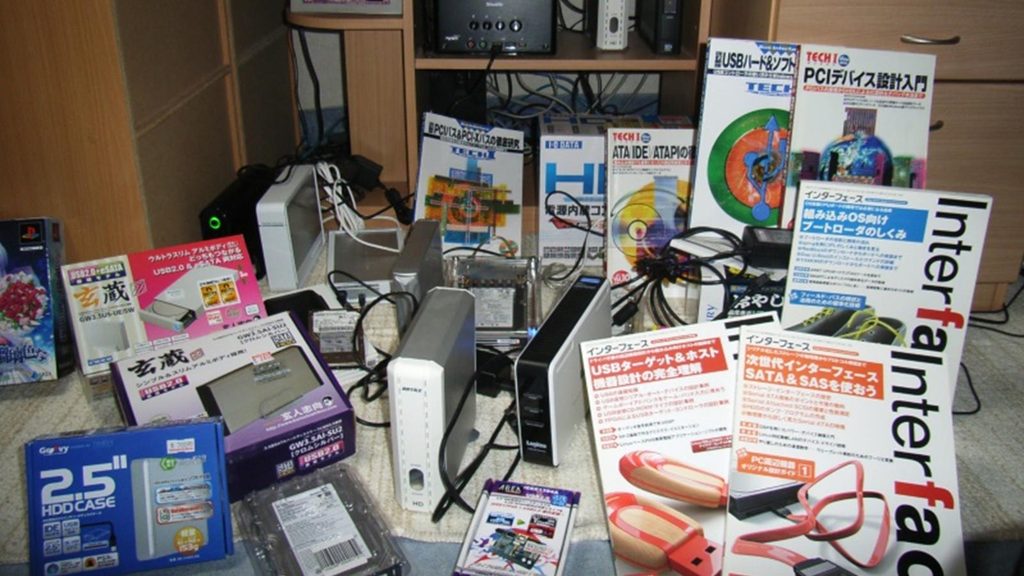
Sometimes I bought devices only to discover that I couldn’t support them after all.
Spending tens of thousands of yen just to confirm that something didn’t work was rather painful.
Worse still, I couldn’t simply throw away the equipment once testing was complete, because I might need it again for regression testing in the future.
As a result, the closets in my home gradually filled up with USB-HDD enclosures.
I suppose a hobby like this can only continue with the understanding and patience of one’s family. (LOL)
As support for more and more devices was added, CrystalDiskInfo continued to grow.
And in December 2008, to my absolute surprise, it received the Mado no Mori Award from the Japanese software publication Mado no Mori (Windows Forest).
Only about six months had passed since the official release. I never imagined that CrystalDiskInfo would receive such a major award so quickly.
I was genuinely delighted.
Above all, without that legendary patch, USB-HDD support might never have become a reality.
A problem I couldn’t solve on my own had been overcome thanks to someone who generously contributed to an open-source project.
That experience had a profound influence on the way I approached software development in the years that followed.
5. A Turning Point in My Life: Shizuku Edition
Looking back on the development of CrystalDiskInfo, there have been several events that I consider turning points in my life.
One of the most significant was the birth of Shizuku Edition.
On June 11, 2011, I exhibited at Open Source Conference 2011 Hokkaido, where I introduced the new email notification feature in CrystalDiskInfo 4.
I had worked quite hard on that feature and was eager to show it off.
Then someone named bellche Tachibana made a completely unexpected comment.
“Email notifications are legacy technology! Voice notifications are the future!”
And then came another suggestion:
“You should have a professional voice actress record the notifications!”
Wait a minute… that’s much easier said than done!
I remember being given a long and enthusiastic explanation of just how important voice notifications were during the social gathering afterward.
Considering we had barely met, it was quite an unforgettable experience. (LOL)
To be perfectly honest, I didn’t take the suggestion very seriously at the time.
But a little while later, something extraordinary happened.
Berche had actually arranged for a professional voice actress to record the notifications—and sent me the completed audio files!
And the quality was absolutely incredible.
What on earth was going on?
Was I going to receive an enormous invoice later?
Was this really all right?
I suddenly had quite a lot to worry about. (LOL)
Still, after someone had gone to such extraordinary lengths to help, I couldn’t possibly respond with a half-hearted implementation.
And if we were going to add voice notifications, why not introduce a character as well?
So this time, I proposed expanding the idea into a full character edition and even asked Berche to help arrange an illustrator.
Quite a bold request to make of someone I had only recently met, wasn’t it? (LOL)
But Berche kindly agreed, and we were able to commission professional illustrator Kasumi Kirino to create the character design.
That was how CrystalDiskInfo’s official mascot character, Shizuku Suisho, was born.
If we were going to do this, I wanted to make it the best it could possibly be.
We carefully developed the concept to bring out the character’s charm without compromising CrystalDiskInfo’s usefulness as a practical storage information utility.
Finally, on June 16, 2012, we unveiled CrystalDiskInfo 5 Shizuku Edition at Open Source Conference 2012 Hokkaido.
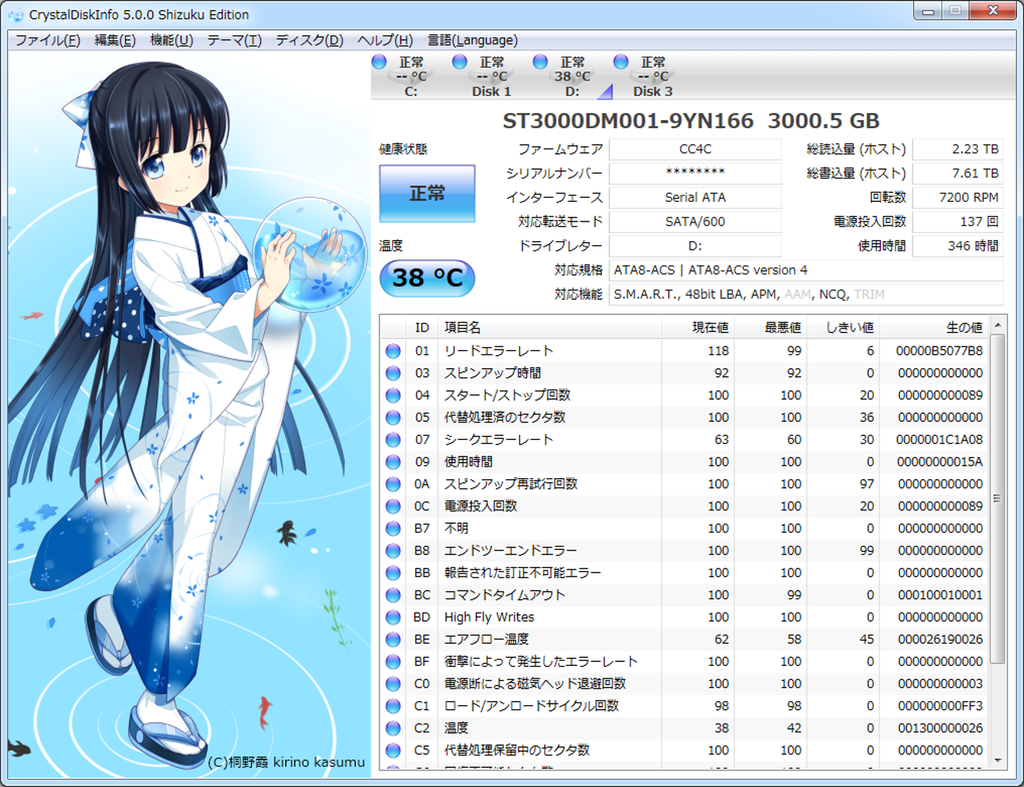
The response was far greater than I had ever imagined.
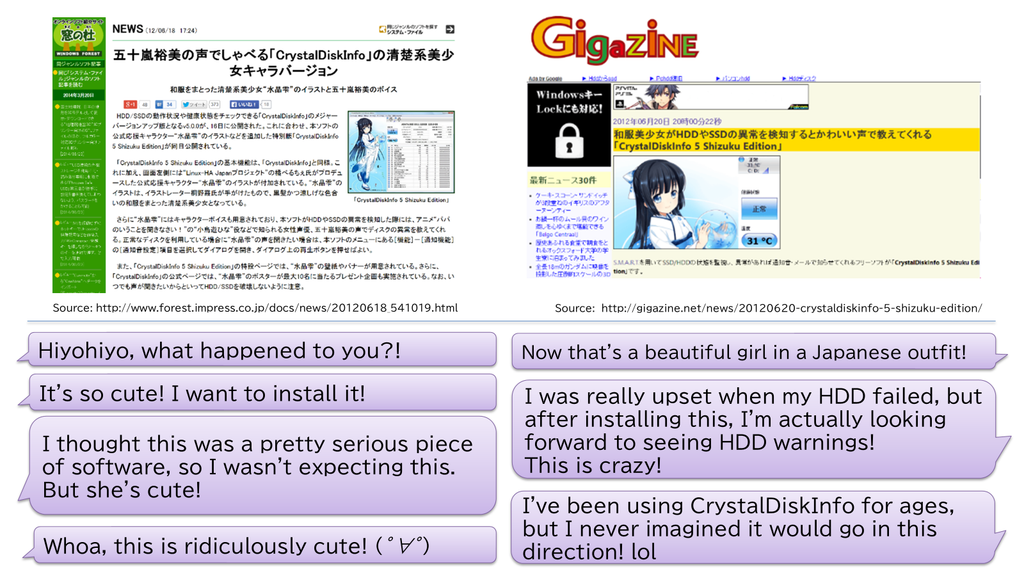
The release was covered by numerous media outlets, including Mado no Mori and GIGAZINE, and users shared all kinds of reactions.
“It’s so cute! I want to install it!”
“I thought this was a pretty serious piece of software, so I wasn’t expecting this. But she’s cute!”
“I never imagined it would go in this direction! lol”
…Yes, that’s right.
Until then, I had been pretending to be a serious software developer. (LOL)
I believe the success of Shizuku Edition helped make subsequent corporate collaborations possible, including MSI Mei Mihoshi Edition and A1Data Erika Edition.
But the biggest change was something much more personal.
Developing CrystalDiskInfo became even more enjoyable than before.
Until then, development had mainly focused on adding support for new hardware and implementing new features.
Of course, that was enjoyable in its own right.
But Shizuku Edition introduced me to the joy of creating something together with people from entirely different creative fields, such as illustrators and voice actors.
Software development really does open up an incredible range of possibilities.
If bellche Tachibana hadn’t spoken to me that day, my life as a software developer might have taken a completely different path.
Once again, I would like to express my heartfelt gratitude to everyone involved in planning and producing Shizuku Edition, and to everyone who has supported it over the years.
6. One User’s Request Led to a Complete UI Redesign
Up through CrystalDiskInfo 5, the user interface was built using HTML and CSS.
This made it relatively easy to customize the appearance, which was quite convenient.
However, differences in Internet Explorer versions and settings sometimes caused display problems, and I had been struggling with these issues for some time.
Then, one day, I received an unusual request from an overseas user.
“CrystalDiskInfo 5 Shizuku Edition doesn’t work on Server Core! Please fix it!”
Server Core is a minimal installation environment for Windows Server.
Because the user interface depended on Internet Explorer, CrystalDiskInfo couldn’t run properly in that environment.
Wanting to use Shizuku Edition on Server Core… now that’s dedication! (LOL)
Still, a user had taken the time to make the request.
So I decided to take the opportunity to eliminate the Internet Explorer dependency entirely and rebuild the UI using GDI/GDI+.
This turned out to be quite a challenge.
The most difficult parts were supporting HiDPI displays and preserving the appearance of Shizuku Edition.
I adopted a fixed layout based on four-pixel units and rebuilt the entire interface to accommodate different display scaling factors.
It was a tremendous amount of work, but in the end, I was finally able to eliminate the long-standing dependency on Internet Explorer.
And it all began with a request from just one user.
You never know where the next opportunity for improvement might come from.
7. Another Hero Appears! This Time from Korea
In 2015, I encountered another major obstacle.
NVMe SSD support.
NVMe was a new interface designed for SSDs, with an architecture very different from the ATA technology I had been working with.
I wanted to add NVMe support, but at the time, there was no straightforward way to send the necessary NVMe administrative commands in the Windows environment.
I researched the problem extensively, but couldn’t figure out what to do.
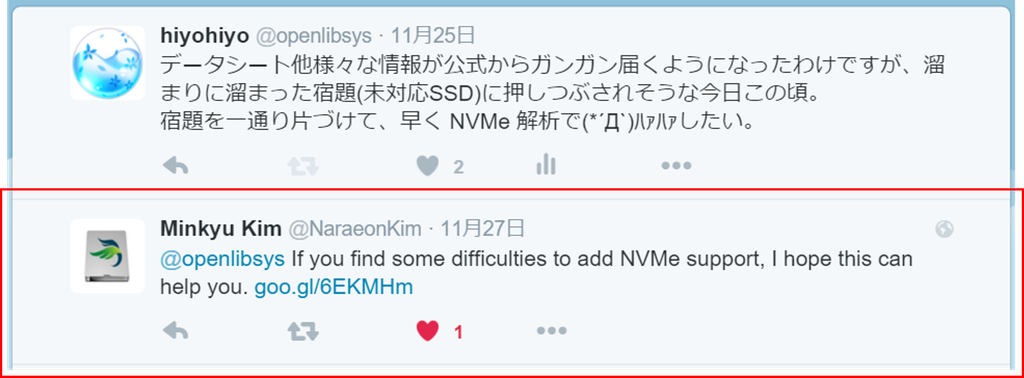
Eventually, I posted on social media that I wanted to support NVMe but had no idea how to proceed.
To my surprise, I received a reply from a Korean engineer named Minkyu Kim.
I had posted in Japanese, yet someone from Korea had responded!
And even better, he provided remarkably detailed technical information.
At the time, Minkyu Kim was pursuing a Ph.D. at a graduate school in Korea.
He provided tremendous assistance, including rewriting code originally written in Delphi into C++ so that it could be used in CrystalDiskInfo.
Another hero had appeared!
Thanks to his help, NVMe SSD support made enormous progress.
In fact, some of the code he contributed is still part of CrystalDiskInfo today, in 2026.
Just as with USB-HDD support in 2008, I had once again been helped by an engineer outside the project.
There are limits to what one person can accomplish alone.
But when you openly share the problems you’re facing and continue developing open-source software, sometimes someone from the other side of the world reaches out to help.
Of course, that doesn’t happen every time.
Nevertheless, encounters like these are what make open-source development so fascinating.
Minkyu Kim, thank you so much!
8. Persistence Pays Off
When I first started developing CrystalDiskInfo, I sometimes contacted storage vendors to request technical documentation and received no response at all.
With no other option, I had to purchase actual hardware and investigate it myself.
For USB-HDD support, I spent countless hours analyzing undocumented, vendor-specific commands.
NVMe support also presented its own collection of difficult technical challenges.
But after continuing this kind of development for many years, things gradually began to change.
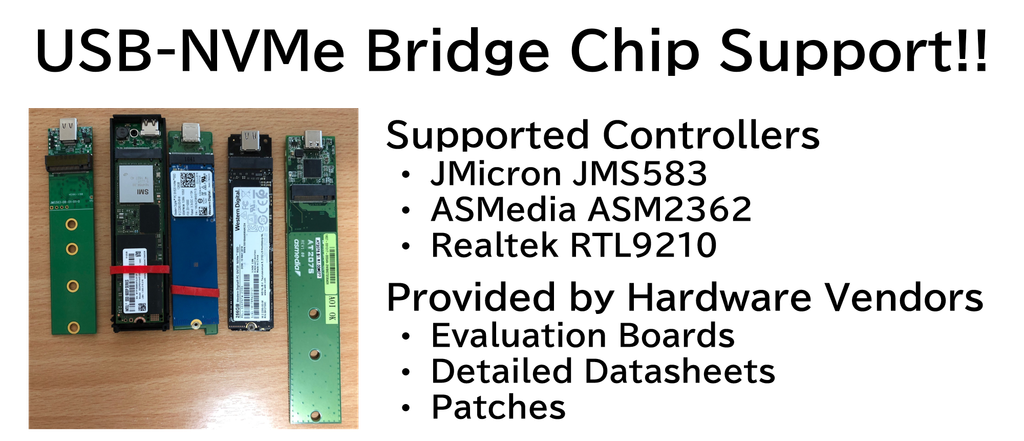
By 2018, I had reached the point where JMicron, ASMedia, and Realtek were contacting me directly to request support for their USB-NVMe bridge chips (JMS583, ASM2362, and RTL9210).
They even provided datasheets and engineering samples for development and testing.
I was truly astonished.
Previously, I had no choice but to wait until a new product was released, buy it, and then investigate how to retrieve the necessary information.
Now, vendors were providing technical documentation and samples before their products went on sale, allowing me to implement support in advance.
Amazing things can happen when you keep working on something long enough.
CrystalDiskInfo also began appearing at international trade shows such as COMPUTEX and CES, where it was used to demonstrate new storage products.
Knowing that software I created is being used somewhere in the world to introduce new hardware is incredibly rewarding.
I believe these opportunities became possible thanks to the users who supported CrystalDiskInfo over the years and the many people who contributed their technical expertise.
I’m truly glad I kept developing it.
9. What Kept Me Going for 18 Years?
One of the greatest joys of developing CrystalDiskInfo is receiving messages from users around the world.
In particular, whenever someone tells me:
“Thanks to CrystalDiskInfo, I noticed the warning signs before I lost my data.”
I feel that creating this software was truly worthwhile.
Losing important data because of a storage failure can be devastating.
Of course, CrystalDiskInfo cannot detect every failure in advance.
But if it has helped even one person reduce the risk of losing valuable data, there is no greater reward for me as a developer.
It has also been tremendously encouraging to know that people continue using CrystalDiskInfo year after year, and that many recommend it to their friends, families, and colleagues.
There is a Japanese saying that I have always valued:
“Nasake wa hito no tame narazu.”
It is often interpreted as meaning that kindness shown to others will eventually come back to benefit you as well.
When you keep doing things that make others happy, good fortune sometimes finds its way back to you.
That is exactly what I have experienced, time and time again, throughout the development of CrystalDiskInfo.
Users initially provided ideas for improvements.
When I encountered technical difficulties, fellow engineers offered their help.
As support for more hardware was added, CrystalDiskInfo became useful to even more people.
And as the user base grew, storage vendors themselves began offering their cooperation.
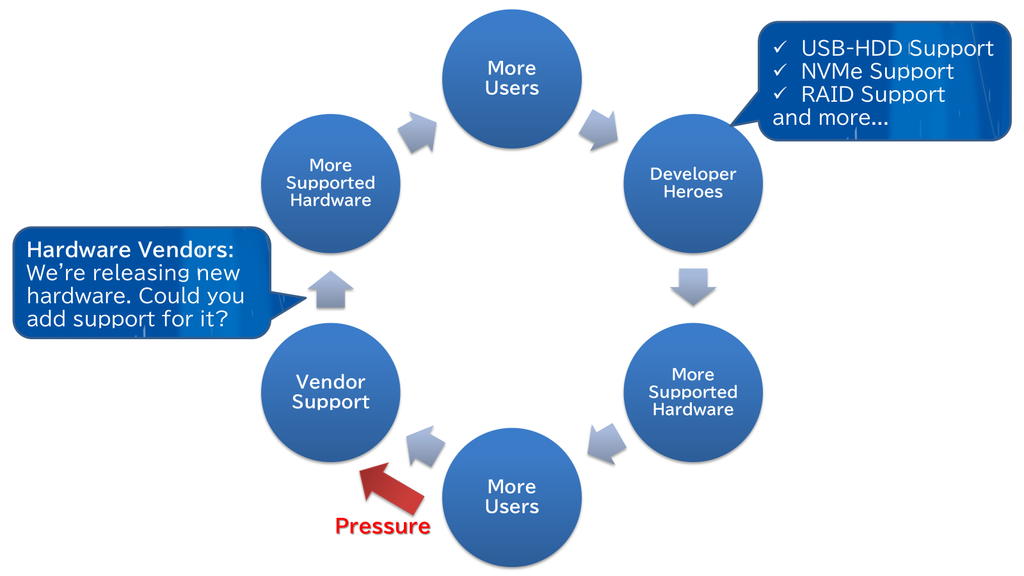
Looking back, I realize just how many people have helped me along the way.
There is one more important reason I have continued for so long.
I still genuinely enjoy developing software.
Whether it’s adding support for a new piece of hardware, solving a particularly difficult bug, or completing a new character edition, the sense of accomplishment still makes me happy.
Of course, things don’t always go according to plan.
But as long as there are things I want to create, I hope to keep developing software.
10. Thank You for Everything
It has been 18 years since CrystalDiskInfo was first released.
Looking back, I have been fortunate to meet and work with so many wonderful people.
To the users who offered honest, sometimes critical, but valuable feedback.
To the programmers who wrote code and contributed patches to help solve difficult technical problems.
To the translators who helped make CrystalDiskInfo accessible to users around the world.
To everyone who reported bugs, suggested new features, and helped test the software.
To the storage hardware vendors who provided technical documentation and evaluation equipment.
To the people in the media who introduced CrystalDiskInfo to wider audiences.
To everyone involved in planning and producing Shizuku Edition and the other character editions.
And above all, to the users around the world who have continued using and supporting CrystalDiskInfo over these 18 years.
Thank you, from the bottom of my heart.
Thanks to all of you, CrystalDiskInfo has grown little by little and has now reached the remarkable milestone of 100 million cumulative downloads.
Storage technology will undoubtedly continue to evolve, and I am sure that every new standard and product will bring another set of technical challenges.
Eighteen years ago, I thought that storage technology was so well standardized that I wouldn’t need to make major changes every time new hardware appeared.
Well… things didn’t turn out to be quite that simple. (LOL)
Nevertheless, researching new technologies, experimenting with them, and finding ways to support them is still something I truly enjoy.
I hope to continue improving CrystalDiskInfo, one step at a time, so that it remains useful to people around the world.
Thank you so much for these wonderful 18 years.
I hope you will continue to support CrystalDiskInfo in the years ahead!
Appendix: CrystalDiskInfo Development Codenames
The major versions of CrystalDiskInfo have been assigned development codenames inspired by works from the Japanese game developer August.
| Release Year | Version | Codename | Inspiration |
|---|---|---|---|
| 2008 | 1 | Feena | Yoake Mae yori Ruriiro na |
| 2008 | 2 | Earthlight | Yoake Mae yori Ruriiro na |
| 2009 | 3 | Moonlight | Yoake Mae yori Ruriiro na |
| 2011 | 4 | Licia | Aiyoku no Eustia |
| 2012 | 5 | Cynthia | Yoake Mae yori Ruriiro na |
| 2013 | 6 | Freesia | Yoake Mae yori Ruriiro na |
| 2016 | 7 | Marguerite | Yoake Mae yori Ruriiro na |
| 2018 | 8 | Marginality | Yoake Mae yori Ruriiro na |
| 2023 | 9 | Rugenia | Iris Mysteria! |
The codename for the very first CrystalDiskInfo 1.0 was “Feena.”
Eighteen years have passed since then, but I continue developing software with the same feelings that inspired me back in those early days.
Once again, I would like to express my heartfelt gratitude to August for creating such wonderful works and inspiring my passion for software development over so many years.
References
- Google, Failure Trends in a Large Disk Drive Population (2007)
- CrystalDiskInfo Internals: Mastering S.M.A.R.T. (2018)
- Behind the Scenes of CrystalDiskMark & CrystalDiskInfo Development (Microsoft Ignite 2022)
- CrystalDiskInfo Official Website: https://crystalmark.info/
- CrystalDiskInfo Source Code: https://github.com/hiyohiyo/CrystalDiskInfo